
One Step Closer. The forest is coming along.
This is the painting I donated two years ago.

The Misery Whip.
This was posted at:
Prints available at Fine Art America

One Step Closer. The forest is coming along.
This is the painting I donated two years ago.
The Misery Whip.
This was posted at:
Prints available at Fine Art America

The color is going on and the background is developing. Time to grow a forest. I’m well into the awkward phase and the quality of the photo isn’t very good.
It was a perfect day in the woods. I was visiting a more modern logging crew.
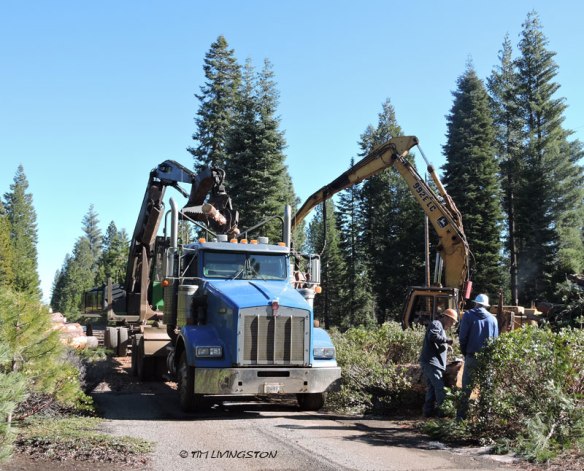
Loading the truck and filling out the load receipt.
What do you think the steam donkey crew would have said about this equipment.

A dozer skidding in a log turn.
I get to go to places like this when I’m at work.
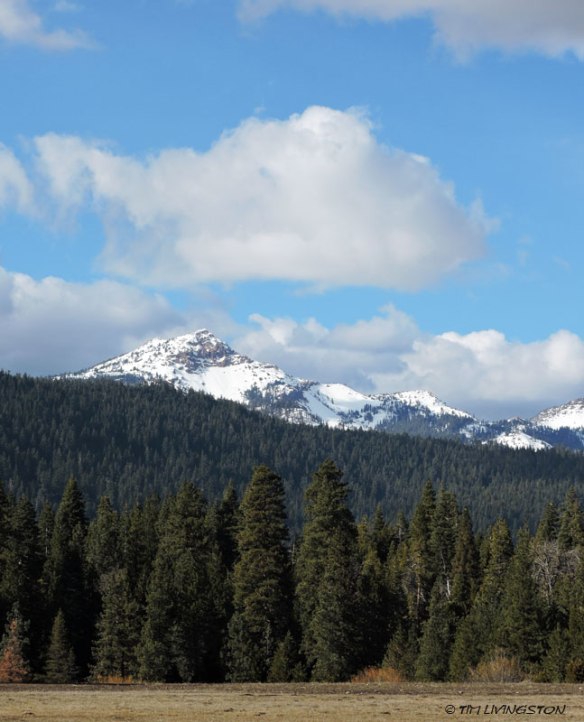
Looking north toward Lassen Park.
Nothing like a little inspiration on the way home to prepare for painting.

Sunset over the Sacramento River.
Today I’m coming to you from the Trinitys. I happen to have a cell signal so I’m making this post with my iPhone. Many of you may know that we are in a severe drought here in California. You can see by the dust coming off this logging operation how dry things are. Our logging crews are suffering with the dry conditions and the dust. Full fire precautions are in effect. Fire season has been pretty brutal this summer. We’re crossing fingers and hoping for the best for the rest of the logging season.

Dust is flying, hazy smoke is in the air and Trinity Lake, in the background behind the lower left trees, is down to about 30% capacity. It’s dry dry dry out there.

A managed redwood forest.
Last week, I was in the redwood country of our coastal mountains. However, I wasn’t down in the parks with the gigantic and ancient trees. As you might imagine, I was in young, working redwood forests.

Wild Foxglove
It’s beautiful country and full of surprises. One of the surprises you’ll find in these forests are the old stumps of the ancient forest giants that were logged over a hundred years ago.

A giant redwood stump.
These old stumps tell a story of the past. The stump pictured above looks like it has two eyes. The “eye” on the left is a spring-board hole. Way back when, the timber fallers would cut a notch in the tree up above the butt swell. They then wedged a board into the notch. They stood on the board, called a spring-board, to cut the tree down. Two man teams with double bit axes and cross-cut saws fell these trees. The spring boards elevated the fallers up the tree where it wasn’t as thick, making it easier to cut. That’s why these stumps are so tall.
Many of these stumps are charred on the outside. The fires that caused this may have been intentional. It was a common practice of the time, to burn the logging site after the trees were felled. They did this to eliminate slash. After the big trees were cut the slash was so deep it was difficult for a man to get through it. The fire solved this problem and left burned stumps behind.

This redwood stump is fifteen feet across.

A spring board hole cut into the stump.

Looking west from the Coast Range toward Humboldt Bay and the Pacific.
I did a watercolor of a logger bucking a log with a cross-cut saw, which is showing in my post Misery Whip – The Final. Timber fallers on spring-board would be a good subject for an illustration. I might have to work on that. Happy Friday.
Every now and then, I come across a special tree. One that was left unharvested because it so inspired people. The landowners left this tree when they logged the property. The ones that owned it next also left it, and so it goes. This tree is 7′ 3″ in diameter at breast height (DBH). The largest Ponderosa pine on record today is 9′ 2″. The Guardian isn’t the biggest, but it’s a big BIG tree.

The sign reads, “The Guardian Borne ? Age ? May You Live Forever”
That’s a nice sentiment, but it won’t happen. Trees, like people, have a limited lifespan and Ponderosa pines if left to grow their natural lives rarely survive to 500 years. However, one Ponderosa was measured at 933 years. Like the sign says, “Age ?” for The Guardian.

What brainiacs decided it was a good idea to graffiti this tree with chainsaws? Ponderosa pine has flaky bark that sheds off. If they would leave it alone for a couple of decades, most of the carving would disappear.
It’s always a Kodak moment when I come across one of these forest giants. Some that I’ve seen included an 8′ plus sugar pine near McCloud, the 8′ “Mother Viola” sugar pine near Viola (now deceased from a huge wind storm), a 7′ western white pine near LaPorte and a 10′ Douglas-fir near Quincy, all in California.

I parked close to the tree as a size reference. Many of the young trees below are it’s offspring.
If your are interested in the biggest trees in the United States, you can check out the Big Tree Registry.

Meet Skidder, no he’s not my dog. He belongs to the logging crew I was visiting. Yes, I gave him back, after a ride in my truck.
Have you ever read a tree? Trees write stories for us to read, if you know how. They write their stories with tree rings. Trees grow a new ring each year. There have been many papers written on how tree rings from old trees show us climate cycles during the life of a tree. This type of study is called Dendroclimatology.
The tricky part of determining climate history from tree rings is that climate is only one variable that affects tree growth. Using tree rings to examine climate is best done with very old trees. Knowing what the forest was like around the tree as it grew, is also important. Corroboration with other old trees in the area is essential. In the early years of a tree’s life, it is often influenced much more by local factors other than climate.
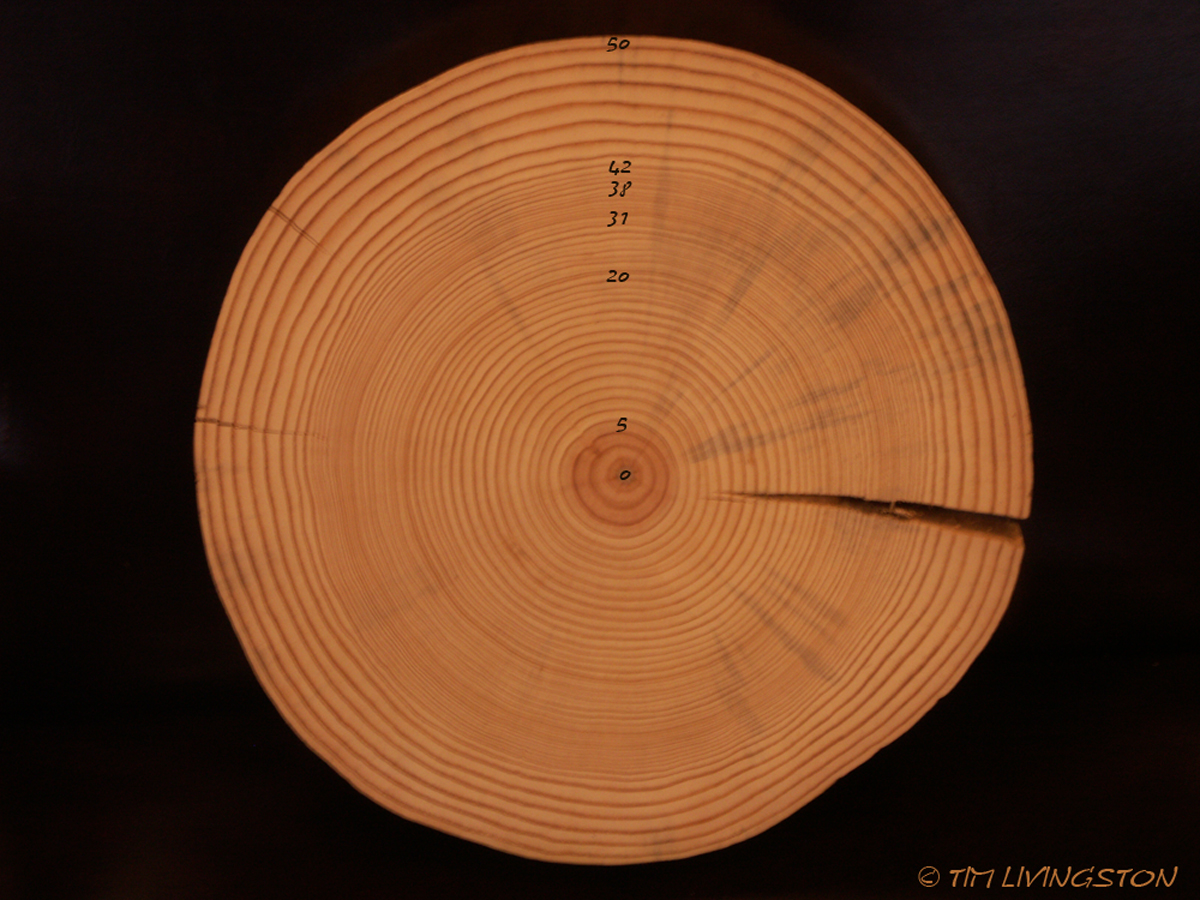 Above is a cross-section of a 50-year old Ponderosa pine tree. Let’s read it. This tree doesn’t tell us about climate, it tells us about it’s neighborhood. The numbers represent the age of the tree at that particular point.
0 years – In the beginning, was the seedling. The tree seeded into an opening in the forest. Perhaps, the opening was a result of past timber harvesting or fire.
5 years – The rings were wide and the tree was growing fast. At this time, the rings began to get smaller because the young tree was starting to compete with the neighboring saplings.
20 years – The tree continued to grow at a slower rate, but the competition with the neighboring trees was really beginning to slow it’s growth. The foliage (crowns) of the trees grew together as the trees bumped into each other.
31 years – The timber stand was very dense as the trees grew together. The lower limbs died since little sunlight reached them. With fewer limbs and foliage, the tree made less energy. The tree was growing very slowly.
38 years – Something changed in the neighborhood, because this tree started growing a little faster. The timber stand may have been thinned in a logging operation, or some neighboring trees may have died from insect attack. Something reduced the number of neighboring trees. With fewer trees around it, our tree had less competition. It received a greater share of sunlight, water, and nutrients.
42 years – After a few years with less competition, the crown grew into a bigger, better, energy making factory. Upon recovering from heavy competition, the tree had the capability to grow faster.
50 years – The tree was harvested.
Now that you have seen it done, can you read a tree? Put on your detective hat and give it a try.
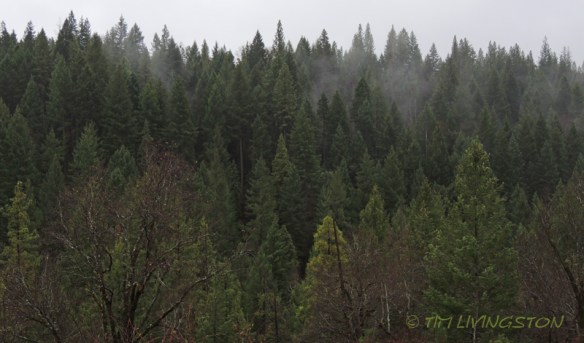
After years of fire suppression efforts, our forest have become very dense.
One of the biggest problems in the western forests of the United States is that we have too many trees. It used to be, frequent fires kept the undergrowth clear without killing the older mature trees. Fuel loads weren’t allowed to get too high. With less fuel built up in the forests, fires burned at low intensity.
Much of our forestland is choked with thickets of trees. Timber stands have grown dense from a century of full fire suppression. These thickets are susceptible to insect attack and drought stress mortality. Fuel loads in the forest are huge. The fires of today burn at such high intensity that it is difficult for firefighters to fight them safely. We are now having larger and more destructive fires, such as the Rim Fire that burned into Yosemite National Park.
Thinning so many small trees was slow and expensive, but with today’s modern logging technology we now have the ability to thin these timber stands efficiently.
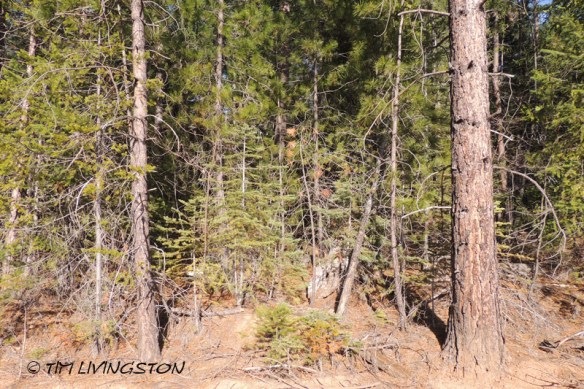
Thickets like this provide ladder fuels that cause crown fires.
First, the sawlogs are harvested for lumber. Next, the biomass is harvested and put into doodles. Biomass are the trees or tops of trees that are too small for products like lumber, poles or veneer. Doodles are harvested bundles of small trees.
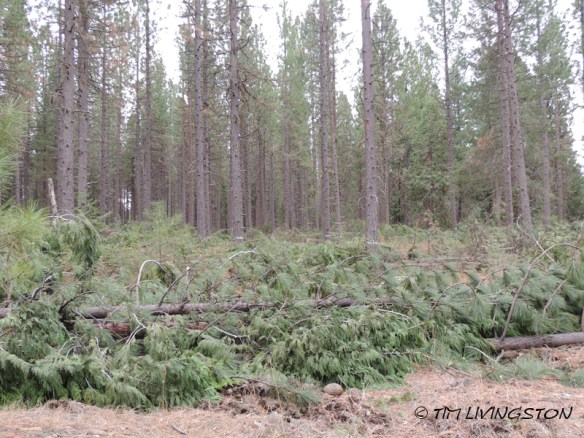
Doodles
The trees marked in white are the “save” trees that won’t be harvested.
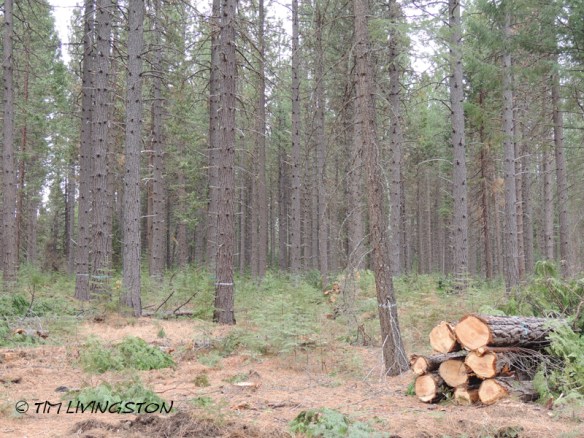
Thinning out the excess trees.
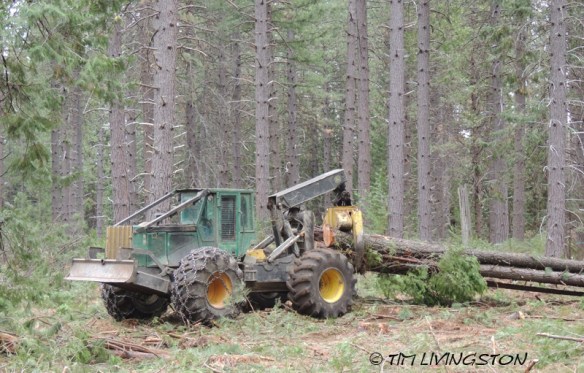
Skidding logs.
Sawlogs being skidded into the landing.
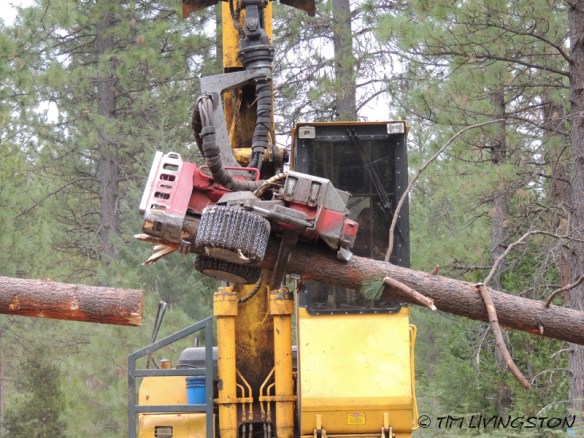
Log processor
The log processor manufactures the trees into logs.
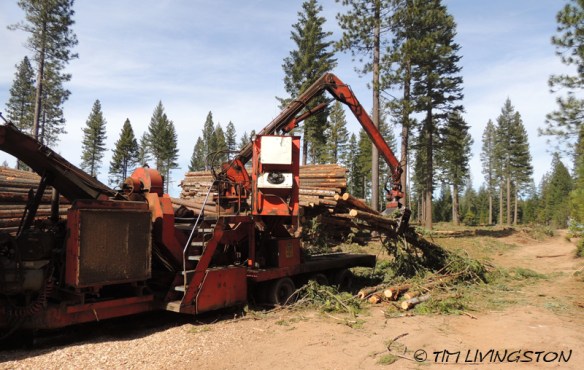
Chipper
The small trees are chipped into a van to be hauled to the co-generation plant and turned into electricity.

Thinned stand
Thinning these timber stands leaves them more resistant to fire and insect attack. A healthy fire is the goal.

Blitz, the canine wood chipper, says, “I’ll chip this doodle myself.”
What’s a masticator? Think of it as a big mobile wood chipper, or a mower on steroids. You may have seen these machines grinding up brush on the side of the road. They’re also used in forestry applications.
I came across a brush clearing operation on the neighbor’s property. Our neighbors happen to be a large government agency. They were shut down because a much needed rain storm made the woods too wet for operating. They were thinning a thirty plus year old Ponderosa pine plantation and removing competing brush with masticators. The thinned trees weren’t big enough to harvest for sawlogs. Masticating an area is expensive, but it makes the plantation more fire resistant and spaces out the residual trees for better growth.
Farther down the road, they used masticators to create a fuelbreak. This provides a break in heavy fuels giving firefighters a defensible line to make a stand against an oncoming wildfire. Shredded and crushed wood from the masticated brush is left on the ground. This woody debris still burns, but the flame lengths and rate of spread of a fire are reduced, thus making it manageable for a fire crew. It’s also a location that a fire crew can use for backfire operations. Over time, this material will decompose, further lessening the fire risk.
The current fuelbreak was originally cleared as a firebreak during the Finley Fire in 1990. A fuelbreak is a change from a heavy fuel type, such as brush, to a lighter fuel type like grass. A firebreak is the removal of all fuel down to bare dirt. After the fire, we replanted our section of the same fireline in 1992. Our trees are now twenty-two years old. As these trees grow larger, they’ll be developed into a shaded fuelbreak. A shaded fuelbreak utilizes the shade of trees to suppress the growth of underbrush. This keeps fuels on the forest floor light. Pruning trees creates a break in the vertical fuel ladder reducing the chance that a ground fire becomes a crown fire.
The neighbors didn’t replant trees in the firebreak immediately after the fire. While our section of the fireline grew trees, their section grew brush. Our stand of trees is twenty years along the process of becoming a shaded fuelbreak. The neighbors must continue to retreat the brush to maintain their section of the fuelbreak.
Forestry is a process with a long planning horizon. I commend the neighbors for creating the fuelbreak. This treatment also benefits our property. However, by making the investment in planting trees early, we saved money on brush removal, while accelerating forest restoration at this site.
Click on the image for a larger view.


Take the high road to find mountain hemlock.
If you want to find mountain hemlock you have to get high, or should I say, go high. The mountain hemlock is a high elevation tree of the Sierra and Cascades mountains. You can find mountain hemlock growing at elevations from 6,000 feet to 11,000 feet in the Sierras of California.

Red fir, lodgepole pine and western white pine are common neighbors of mountain hemlock.
Mountain hemlock grows in a wide band along the Pacific coast. Its range extends from the Sierra mountains of California in the South to Southern Alaska in the North. In Alaska it grows in extensive stands down to sea level. This is common with most trees that have a wide north to south range. The farther north you go, the lower elevation you grow.

The hemlock cones look a lot like spruce cones.
It is not commonly harvested in California, because it is not common in California’s managed timberlands. As a result, I don’t run into it very often in my job.
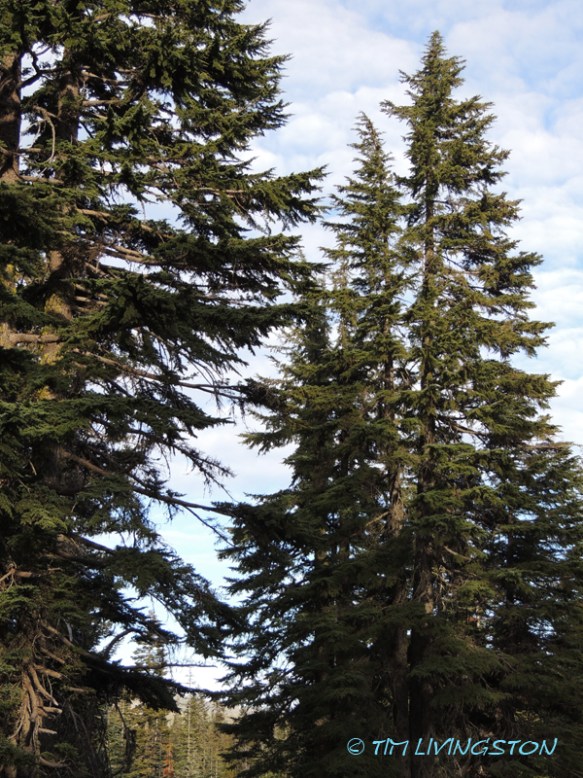
A delicate looking tree living in a harsh place.
Tsuga mertensiana is the scientific name, but let’s really look at this wonderful tree. Hemlocks have a different personality from the other western conifers and that’s what I enjoy about them. They have a bit of a fairytale quality.
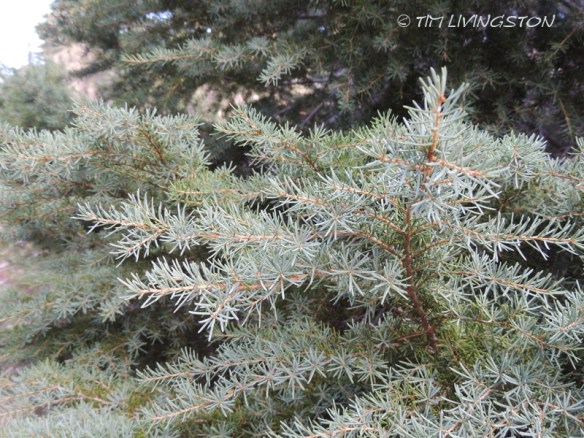
The blue green foliage has a soft appearance and feel.
From its delicate needles to the droopy tips the mountain hemlock has a poetic gestalt, or gesture as artists are so fond of saying.

The tree tops almost have a joyous look about them.

The ubiquitous Douglas squirrel is a common resident up here.
Blitz is back on duty keeping the squirrels in line. What would I do without her.

Blitz giving her best regal pose. Well done girl!
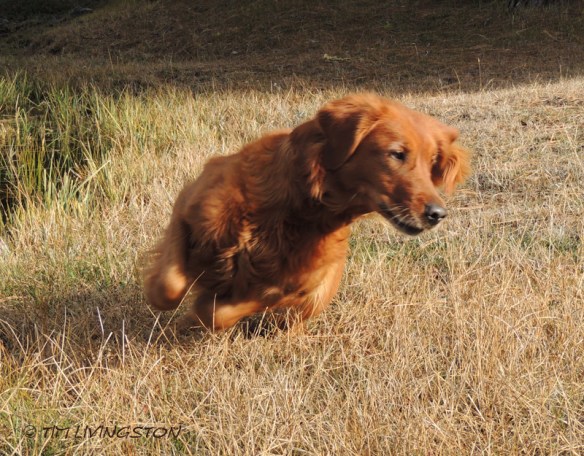
“Whoa squirrel, gotta go!”

After a long day of practicing forestry and chasing squirrels it’s time to head for the barn.
This gallery contains 8 photos.
We’re into our Winter logging season now. In California, logging in the Winter period is much more restrictive than during Summer. We are limited to operating only in “dry rainless periods” or “hard frozen conditions.” Right now we have both. … Continue reading
 THE FORESTER ARTIST