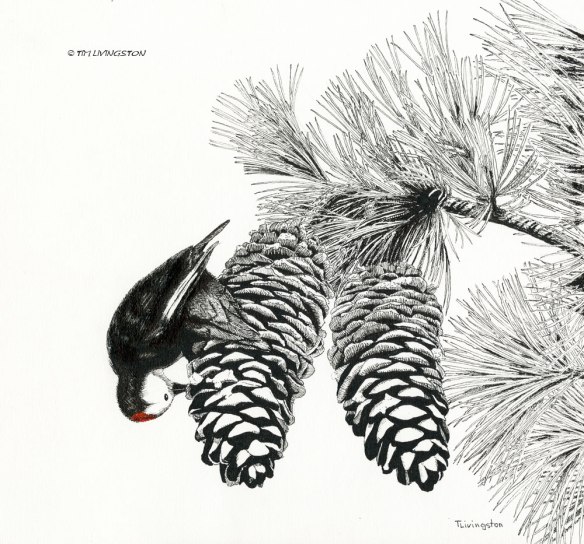
A white-headed woodpecker probing for insects in a sugar pine cone. Pen and ink.


A white-headed woodpecker probing for insects in a sugar pine cone. Pen and ink.
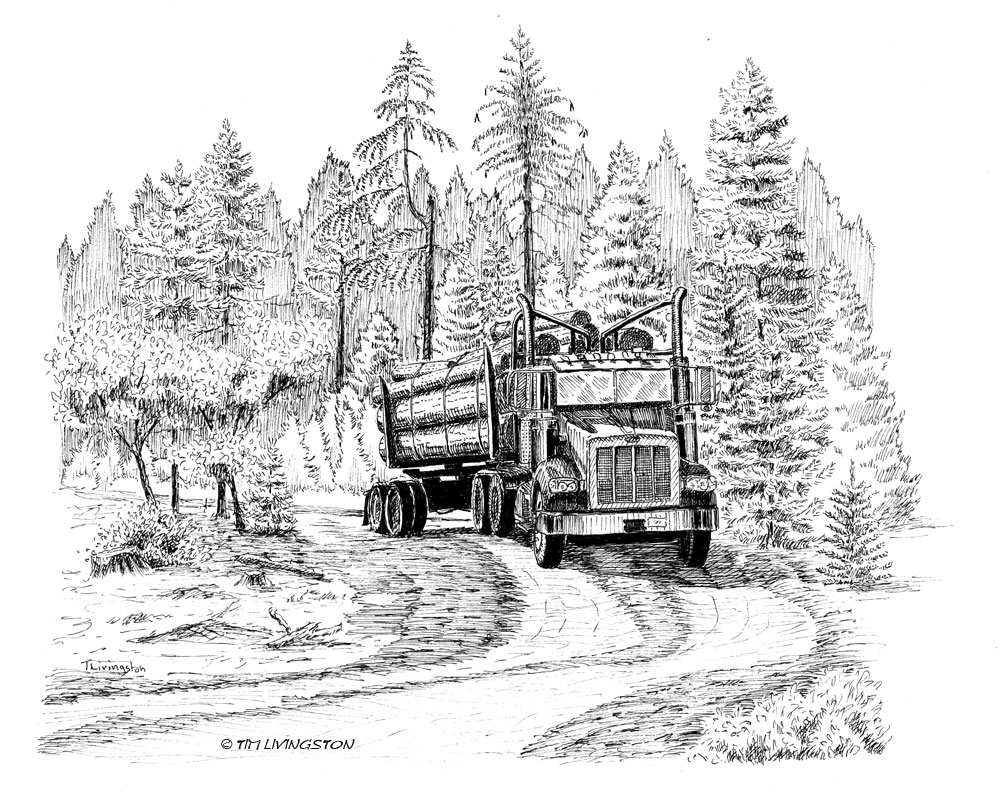
A loaded log truck heading to town.
This pen and ink was inspired when I was headed to a logging job near Trinity Lake in Northern California. It appeared in the children’s book Timber In The Working Forest, by Mary A Livingston and illustrated by yours truly.


Pacific fisher in pen and ink. Mary and I had a chance meeting with a pair of fishers. That’s when I took the photo that this picture was based on. We watched this fisher as it climbed up and down a Douglas-fir tree while it was hunting.
The Pacific fisher is a large member of the weasel family that makes its home on our California timberland.

This was a different Pacific fisher that unknowingly visited us. Observing wildlife from a hidden hunting blind is a great way to watch animals in their natural state.

The fisher investigates our wildlife camera. Come on little fella just a bit farther. Darn, we didn’t get his picture on the wildlife camera.
The company I work for, Sierra Pacific Industries, has been involved in a fisher relocation project for a number of years. Our partners in the project include US Fish and Wildlife Service, the California Department of Fish and Wildlife, and researchers from North Carolina State University. The purpose is to re-establish fisher into parts of the Sierra Nevada Mountains that used to be their historic range. The project has been highly successful. You can read more about the project here at the Fish and Wildlife Service website.

This is a mixed media illustration of a fisher with a radio collar that I did for the children’s book Timber!. The pen and ink version appeared in the young reader book Timber In The Working Forest. Both books were written by Mary A Livingston and illustrated by me. You can read her blog at Sneaking Bliss.com.
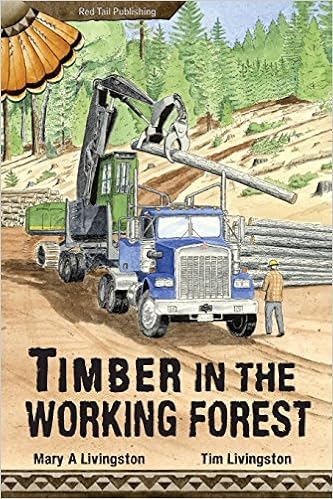

Forester’s Boot, in pen and ink. To be more specific, Forester Artist’s boots!
I did this piece for the book Timber In The Working Forest, written by Mary A Livingston.

Bliss and I were out marking trees a few weeks ago when we came upon several wood rats nests. They build these large stick pile akin to a beaver lodge on land. They are very industrious creatures. They are also an important prey species for forest predators.

Bliss was very impressed with this massive collection of sticks. So impressed that she claimed it for herself. Sadly for her it wasn’t going to fit in my vest and she could only carry one stick at a time.
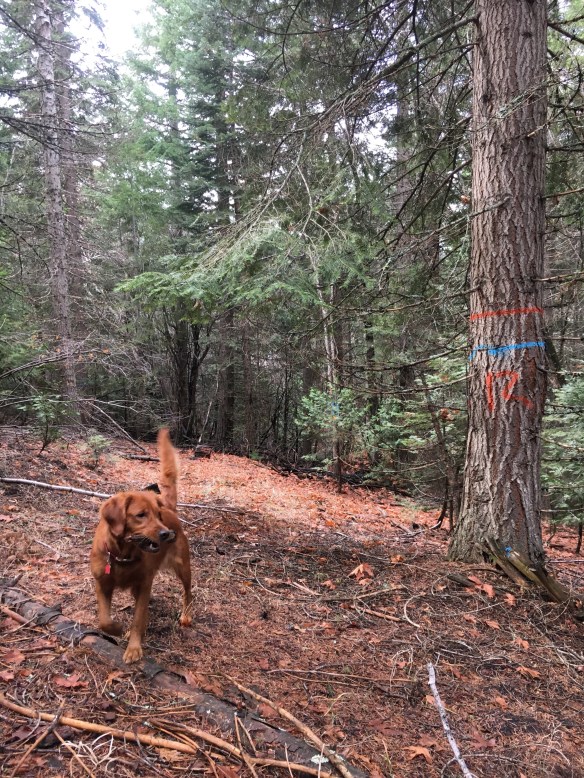

This clever rat built its nest in the trees. No sticks for Bliss from this one.

Bliss found a deer skull under the nest. “No Bliss it’s not a rat skull and no you can’t eat it!”
https://www.zmescience.com/science/northern-forest-britain-09423432/
I found this to be an interesting story on plans to reestablish forests in Northern Britain. It’s a noble goal to be sure. The goal is to plant 62,000 acres back to forest with 50,000,000 trees. The cost is expected to be $690 million. That’s where I start to cringe.
When comparing projects done in California by private timber companies doing wildfire restoration I think it could be done better in Britain. We would use about 20,000,000 trees to do the same size area. With soil site preparation, tree planting and initial herbicide treatment to control the weeds for a year or two, our reforestation cost would be about $25,000,000 for 62,000 acres. Now, if they were to plant the trees in Britain at a 12’x12’ spacing like we would here, they could cover 165,000 acres. Our costs here would be approximately $65,000,000. Plus, planting the trees as close together as they propose, about 7’x7’ will require the trees be thinned within a few short years at substantial expense. Otherwise, the trees become overly crowded and stressed.
This doesn’t sound like forestry, because it really has a price tag for landscaping. I believe it’s a worthy project, but can be done better. I realize our infrastructure for these types of projects is different and cheaper, but that is still a huge cost difference. I also know that many American foresters outside of California are thinking my cost estimates are too high. That’s California. My suggestion is to draft some good Canadian reforestation foresters to come over and lend a hand.
https://www.zmescience.com/science/northern-forest-britain-09423432/
I was in the Trinities this week and there was thick smoke everywhere. It’s burning season in Northern California. We had quite a lot of rain in late November. I assumed that some agency was doing a large burn project. However, I couldn’t see where the smoke was coming from. It appeared to be drift smoke.
During my drive down from the mountains I heard a news report. They reported that smoke from the Thomas Fire was drifting up the coast. I checked Google Earth that evening and the smoke had drifted nearly 500 miles from the Thomas Fire in Southern California to north of Redding. The residue of so many homes and so much wildland was adrift in this smoke.

The late afternoon sun filtering through the smoke in the Trinities.

Looking north toward Billys Peak across the old dredge tailings along the Trinity River.

Smoke tinted sunlight and trees reflect on an old dredge pond.
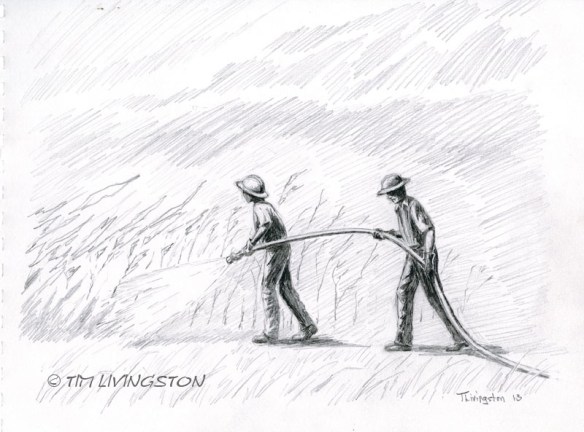
Logging Crew Firefighters.
This story appeared on KREM2 in Spokane. I’m heartened to see a support for an active strategy to deal with the wildfire dilemma. In defiance of popular conventional wisdom that harvesting trees is a bad thing. Finally, using harvesting as a tool for healthier forests. It too long overdue in the minds of the public.
http://www.krem.com/news/local/2-on-your-side/logging-could-it-actually-save-our-forests/484608831
I’m showing off some of our Northern California fall colors. I know you folks back east are thinking “I don’t see the color!” We make do with what we have.


 THE FORESTER ARTIST