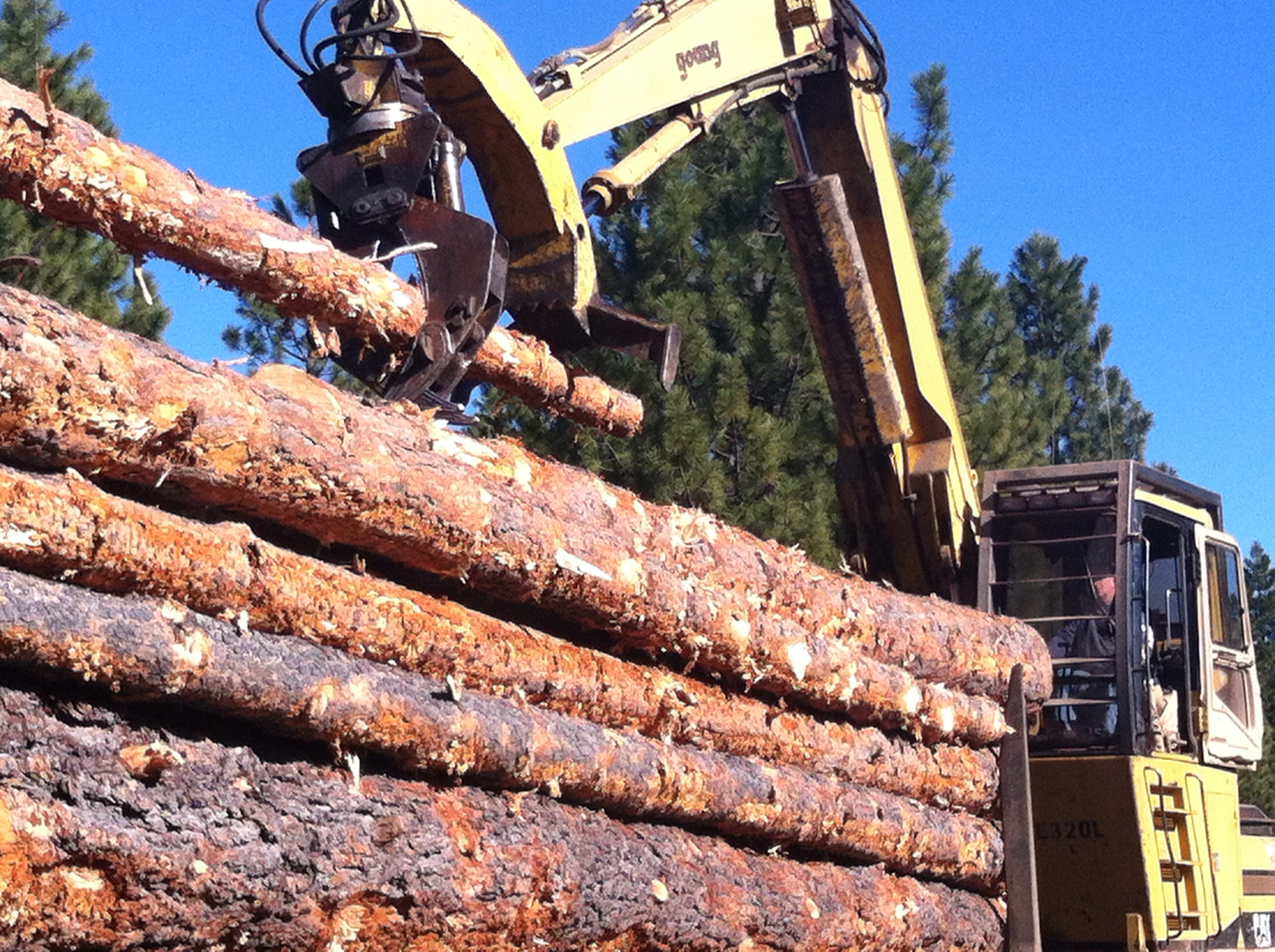
Here’s a shot directly from the landing, today. Tommy’s loading a truck. It’s a beautiful day out west.
I’ll be back on the “Steam Donkey WIP” tonight with an update.

Here’s a shot directly from the landing, today. Tommy’s loading a truck. It’s a beautiful day out west.
I’ll be back on the “Steam Donkey WIP” tonight with an update.
There’s fire in the woods again!
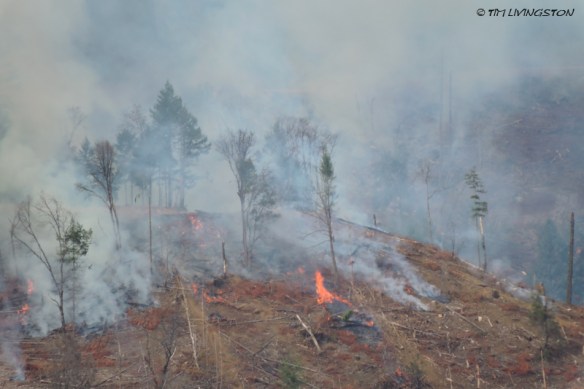
Burning slash in a logging unit. A forester favorite Fall pastime.
Not like the Summer wildfires this time. This burning is for fuel reduction after logging. It’s part of our Fall preparation for tree planting. We prefer chipping slash and hauling it to the co-generation plant where it can be turned into electricity. In some areas that option isn’t available so we have to burn the slash on site. Getting rid of the slash reduces the fuel load for future wildfires that may occur. It also releases nutrients into the soil in the form of ash. Those nutrients give a boost to the young seedlings that will be planted at the site in the Spring.
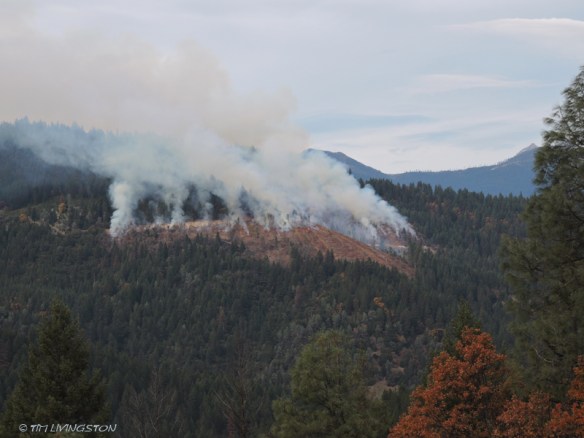
On flat ground the slash is often piled for burning. In this unit the entire site is burned, which is called a broadcast burn.
We aren’t trying to get rid of all debris within units, but we want to reduce it to a reasonable level. A certain amount of slash and debris left unburned acts as impediments to erosion. Over time it breaks down adding organic material back into the soils. However, too much debris creates a fuel load that will support an aggressive wildfire.
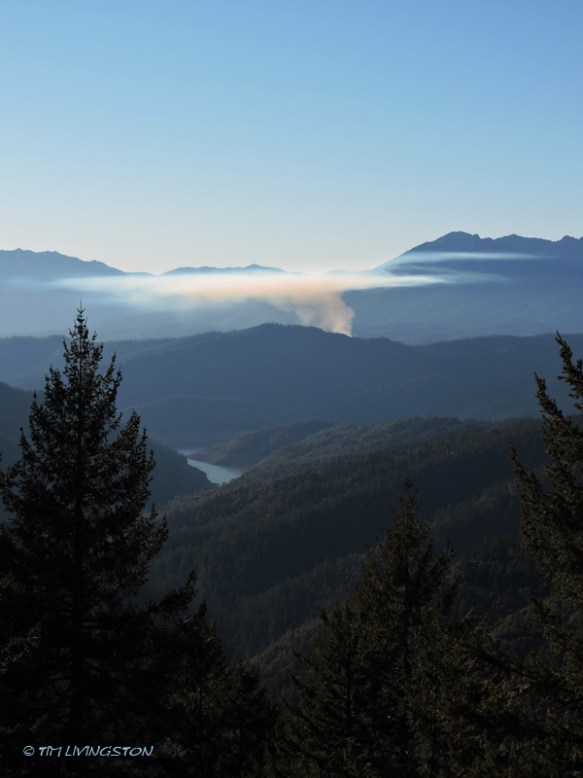
This smoke column rises over Trinity Lake and has reached an inversion layer causing the smoke to flatten out.
Burning is only allowed on specific days when weather conditions are right. We avoid conditions that are too dry in which fire can escape. We also have to be aware of what direction the smoke is being carried on the wind to avoid smoking out populated areas. In California we’re required to prepare smoke management plans to determine what conditions are appropriate for burning as to not create a smoke hazard for local areas.
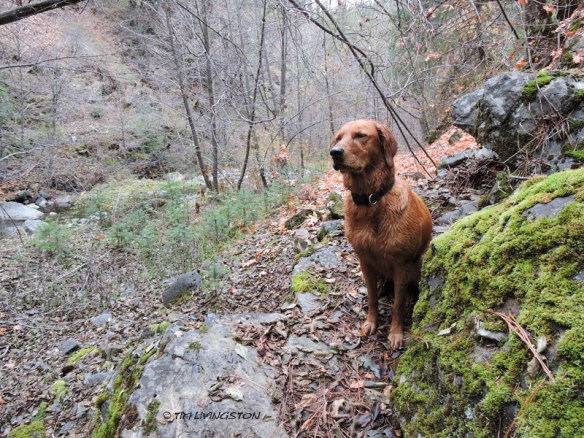
I had a companion on this day. Tessa, our friend’s dog, got to be a forester’s dog for a day.
Fall is traditionally incredibly busy around here and this season has been no different. Things are starting to wind down so hopefully there will more time for posting.
Today I’m coming to you from the Trinitys. I happen to have a cell signal so I’m making this post with my iPhone. Many of you may know that we are in a severe drought here in California. You can see by the dust coming off this logging operation how dry things are. Our logging crews are suffering with the dry conditions and the dust. Full fire precautions are in effect. Fire season has been pretty brutal this summer. We’re crossing fingers and hoping for the best for the rest of the logging season.

Dust is flying, hazy smoke is in the air and Trinity Lake, in the background behind the lower left trees, is down to about 30% capacity. It’s dry dry dry out there.
True fir refers to any species of fir that are in the genus of Abies. Species like red fir, Abies magnifica, and white fir, Abies concolor, are true fir. Douglas-fir, Pseudotsuga menziesii, is not a true fir. The gallery pictures are of a high elevation, old growth true fir forest. This stand is over 6,000 feet elevation. Click the pictures to enlarge.


In this year of drought, our forests are a tinder box waiting for a spark. That spark came from the sky on the last day of July. It reached 108 F in the valley. A major lightning storm rolled across the North State and left numerous forest fires in its wake.

Looking east toward Burney. On the right is smoke from the Day Fire and on the right is the Bald Mountain Fire.
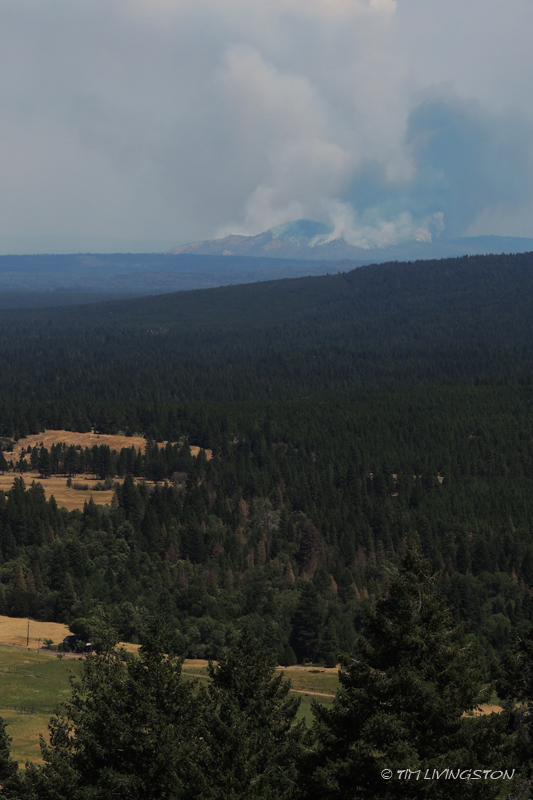
Bald Mountain.
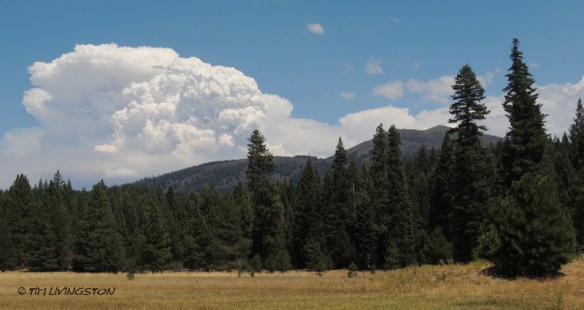
A huge thundercloud forms above the Bald Mountain Fire. Burney Mountain on the right, has a fire lookout on its peak.
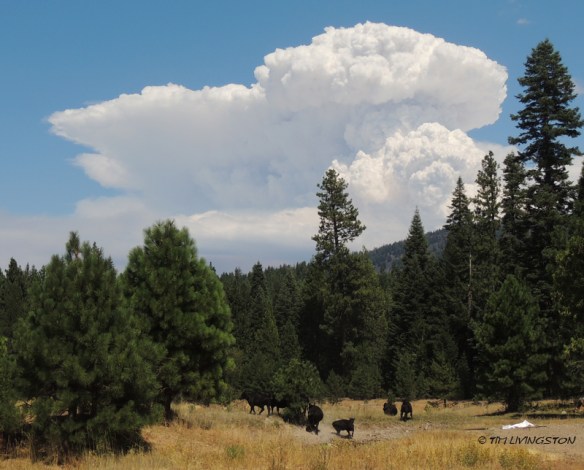
The cloud above the fire continued to grow all day as the fire exploded in size. These clouds create erratic winds that cause the fire to spot.
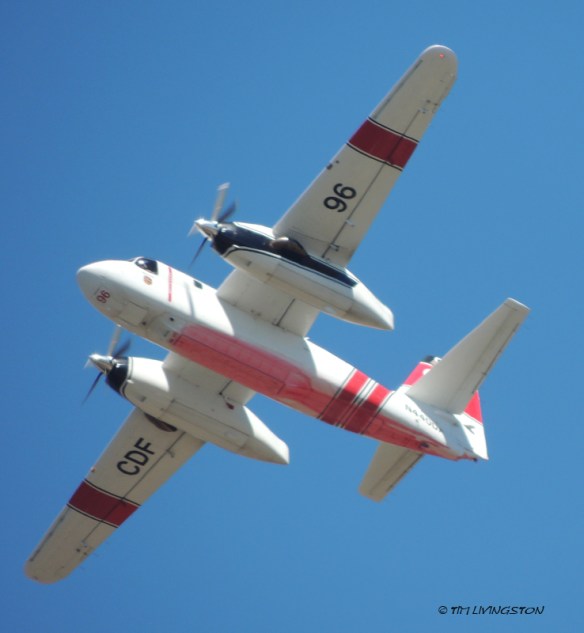
The air tankers bombed the fires throughout the daylight hours. This S2 is on its way to the Coffee Fire.

More fires were burning to the west. This column was from the Coffee Creek Fire.

A new fire called the Eiler Fire took off on the second day. It’s was close to the Bald Mountain Fire. The two fires were threatening the town of Burney. From the valley in Anderson, we could see at least six major smoke columns in all directions.

The beginning of the week brought us a rare and very wet cold front. The rain helped the firefighters get a handle on many of the fires. The same storm created flash floods and mud slides in Southern California.
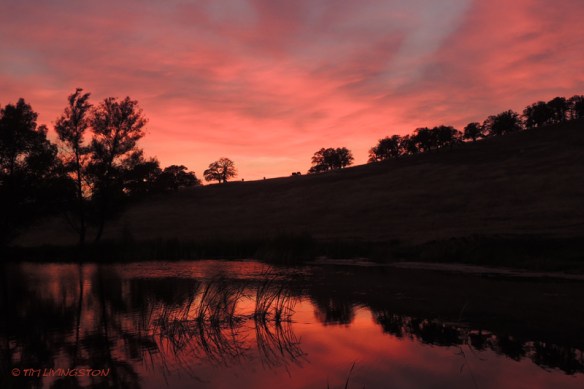
Wildfire sunsets are a silver lining.
Most of the east side fires are under control now, but several fires in the Klamath Mountains are still burning. We still have a long way to go to reach the end of fire season.

A late afternoon thunderstorm builds over the Trinity Alps.
Billowing thunderclouds built up over the Trinity Alps last Wednesday. It was an ominous teaser of desperately needed rain. Our summer thunderstorms are the double-edged sword of rain and lightning. What will it be, soothing rain for parched earth or forest fires? These storms usually cause more grief than relief. I think we’re caught between a rock and a hard place. It’s not as if we get to choose what we get anyway.
Today the monsoonal moisture has returned. We’re already hearing thunder to the south. It could be an interesting day today.
Logging is in full swing and the dust is flying. It’s dry out there and the crews have their fire tools sharp and fire pumpers full.

Craig winds his dozer down the skid trail.
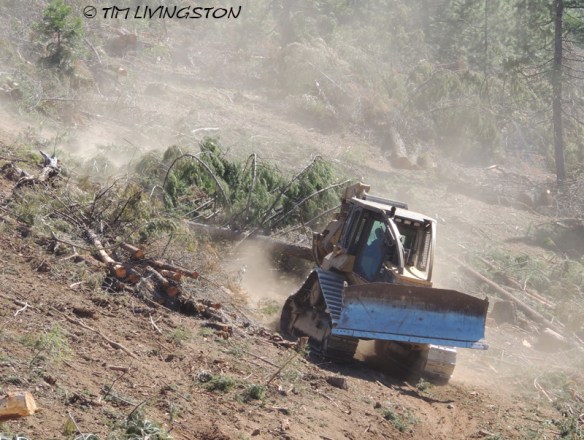
A skid of logs chattering toward the landing.

A load of logs pulls out of the landing. I hope you don’t mind a little dust.
“Bug kill” or “beetle kill” are the terms we use for insect killed trees. Bark beetles kill more trees in our forest than any other insects. They are always present in the forest. At low population levels, the dead trees or snags they create are left for wildlife. When beetle populations spike up, we salvage most of the dead trees.
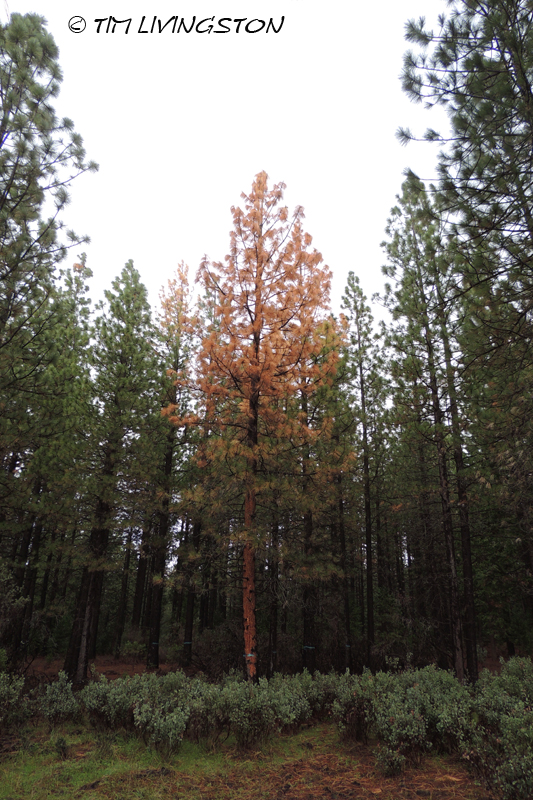
We salvage dead and dying trees to capture their value while the wood is still sound. Red or fading tops signal the problem areas.

This pitch tube is the entry point where the beetle first bored into the tree. If the pitch tube is amber in color, the tree successfully fended off the attack. When the pitch tube is pinkish like this one, the beetles successfully penetrated into the tree.

This is the culprit, a red turpentine beetle, Dendroctonus valens. They bore into the trees to lay eggs. Trees in a weakened state, such as during severe drought, attract these beetles.
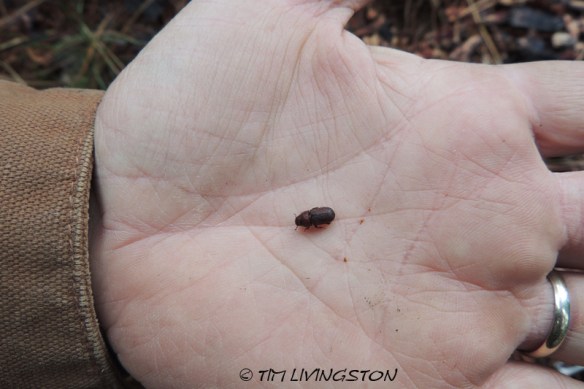
The red turpentine beetle adult, Dendroctonus valens, normally attacks the base of the tree. Such a tiny creature can do so much damage.
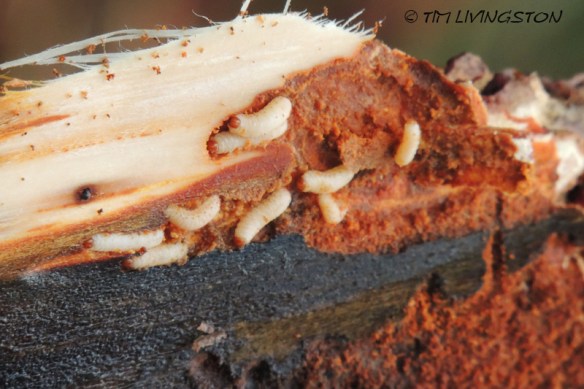
The larva of bark beetles are what kill the tree. The adult beetle chews a nursery gallery into the tree to lay her eggs. The larva hatch and spread out from that gallery creating more galleries as they feed. During this feeding process the larva girdle the cambium of the tree causing it to die.
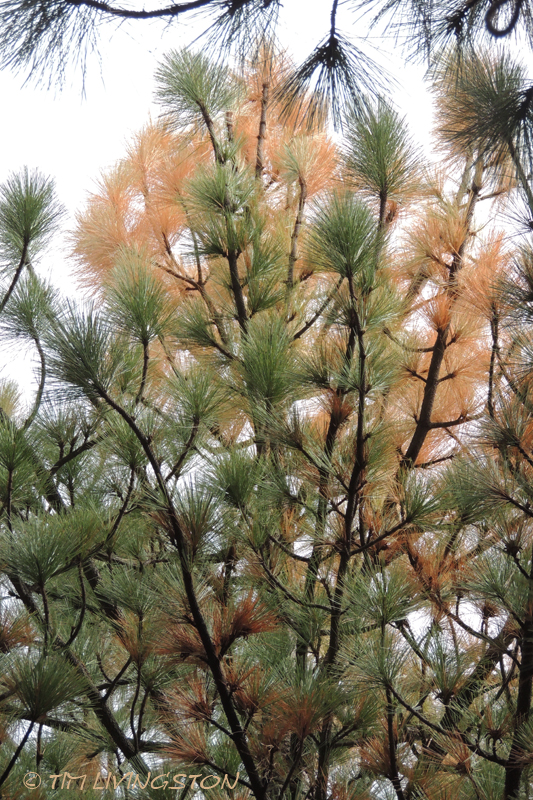
The top of this Ponderosa pine is dead. This in an indication of a different beetle, Ips sp. Location of the attack on the tree can be a diagnostic tool for identification of the insect attacker. There a many species of bark beetles that attack trees.
I’ve been asked over the years what can be done to protect the trees from these beetles. The answer is very little. Keeping your trees thinned out reduces competitive stress between the trees. Reducing stress on the trees is the only effective way to reduce attack by the beetles. However, in years when the beetle populations peak, they will even attack healthy trees. Once you see evidence of beetle attack, it is already too late. Salvaging the dead and dying trees is all that can be done. You have to “log the problem away.”
Every now and then, I come across a special tree. One that was left unharvested because it so inspired people. The landowners left this tree when they logged the property. The ones that owned it next also left it, and so it goes. This tree is 7′ 3″ in diameter at breast height (DBH). The largest Ponderosa pine on record today is 9′ 2″. The Guardian isn’t the biggest, but it’s a big BIG tree.

The sign reads, “The Guardian Borne ? Age ? May You Live Forever”
That’s a nice sentiment, but it won’t happen. Trees, like people, have a limited lifespan and Ponderosa pines if left to grow their natural lives rarely survive to 500 years. However, one Ponderosa was measured at 933 years. Like the sign says, “Age ?” for The Guardian.

What brainiacs decided it was a good idea to graffiti this tree with chainsaws? Ponderosa pine has flaky bark that sheds off. If they would leave it alone for a couple of decades, most of the carving would disappear.
It’s always a Kodak moment when I come across one of these forest giants. Some that I’ve seen included an 8′ plus sugar pine near McCloud, the 8′ “Mother Viola” sugar pine near Viola (now deceased from a huge wind storm), a 7′ western white pine near LaPorte and a 10′ Douglas-fir near Quincy, all in California.

I parked close to the tree as a size reference. Many of the young trees below are it’s offspring.
If your are interested in the biggest trees in the United States, you can check out the Big Tree Registry.

Meet Skidder, no he’s not my dog. He belongs to the logging crew I was visiting. Yes, I gave him back, after a ride in my truck.
When is a pine cone not a pine cone? The answer,… when it’s not! Folks often see a conifer cone and call it a pine cone, but in reality it may not be a pine cone. There are many types of conifers that aren’t pines, such as spruce, true fir, hemlock and Douglas-fir to name a few.

Ponderosa pine cone in pen and ink.
So why do so many folks refer to all conifer cones as pine cones? Apparently, the pines won the branding contest. In the UK many people call refer to vacuum cleaners as Hoovers, in the USA many people call all colas Cokes and conifer cones are pine cones.
Pine cones have thick scales with a little point called an umbo. These images are some of our local pines.

Ponderosa pine cones are the classic western pine cones.
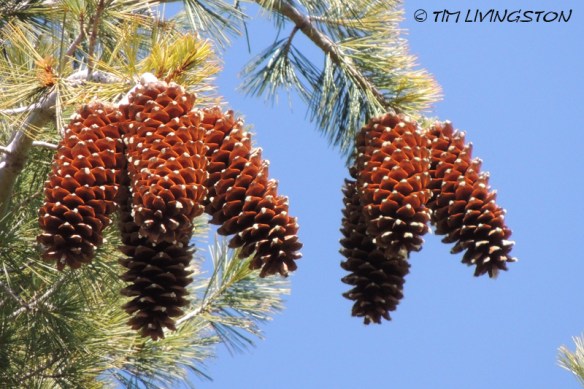
Sugar pine cones are the longest pine cones and reach 24 inches long. Sugar pine are a member of the white pine family.

Gray pine cones are large heavy cones that are very common in the foothills of California.
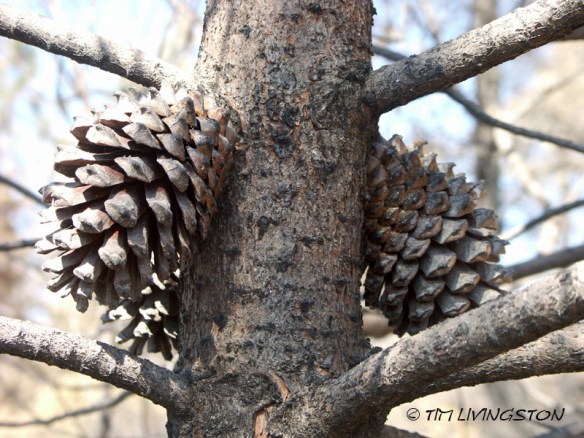
Knobcone pine cones are serotinous cones. Serotinous cones can remain attached to the tree for years and open after fire. These trees are referred to as fire pines.

Lodgepole pine are another fire pine. The cones are usually less than 2 inches wide.

Several years ago my youngest son climbed a Coulter pine tree to collect these beauties. Coulter pine is also called “big cone pine”, because they have the biggest cones of all, up to 10 pounds. These cones resemble a medieval mace.
Many of the non-pine species have thin scales with no point. These are some images of our local non-pine conifers.

White fir cones disintegrate when they’re ripe. White fir is a true fir. True fir cones stand upright on the limb.

It is rare to find intact true fir cones on the ground. This one was cut out of the tree by a squirrel.
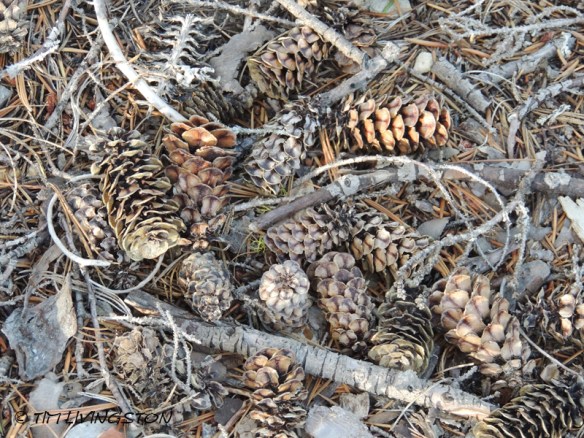
Mountain hemlock have a thin scaled small cone.
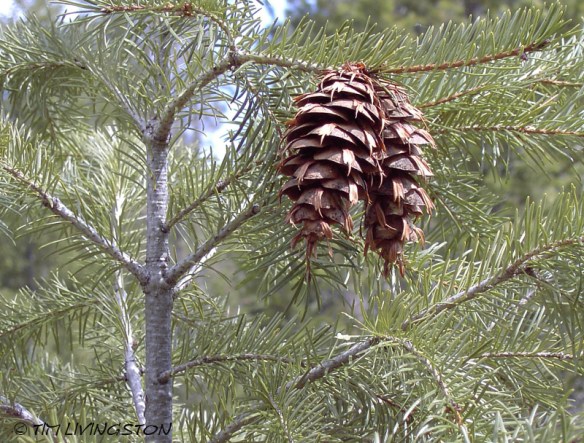
Douglas-fir cones have extended bracts that stick out between the scales.
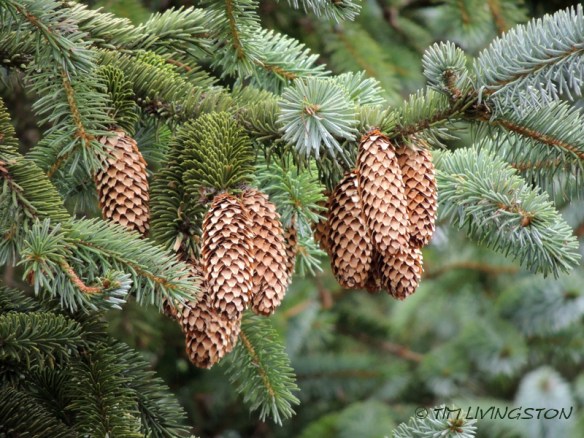
Sitka spruce cones also have thin scales. These spruce grow on the west coast from California to Alaska.
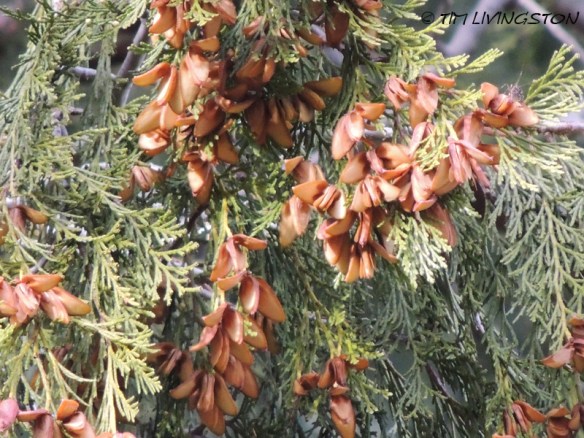
Incense cedar have tiny cones. Incense cedar is used for making wooden pencils.
This is a small sample of some of our local conifers. Next time someone calls a non-pine cone a pine cone, you’ll be ready to give them a forestry lesson.
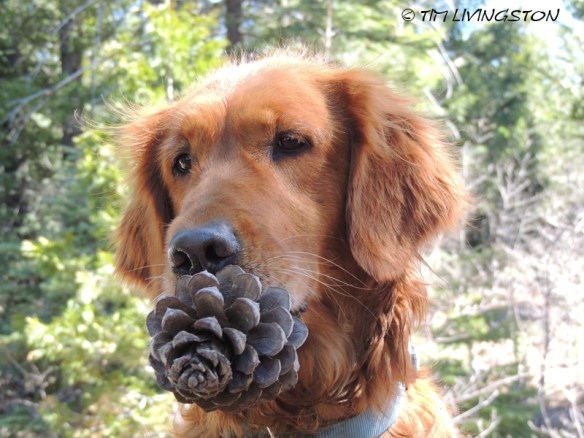
It just seems right to end this post with a picture of Blitz. She’s still here in spirit.
 THE FORESTER ARTIST