Forestry Friday … Millions of Dead Trees

This story appeared in the May 2015, California Forest Pest Council newsletter. The effects of the drought are manifesting in Southern California forests through massive tree die-off.

Early Aerial Surveys Find Millions of Dead Trees 

TehachapiBugKill

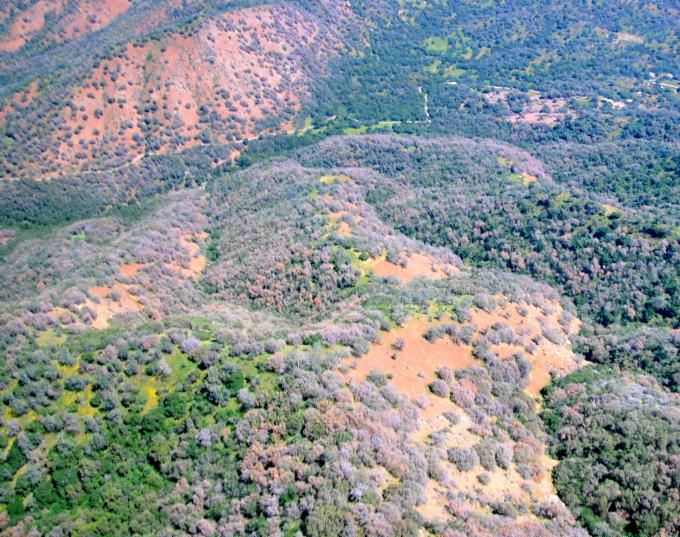
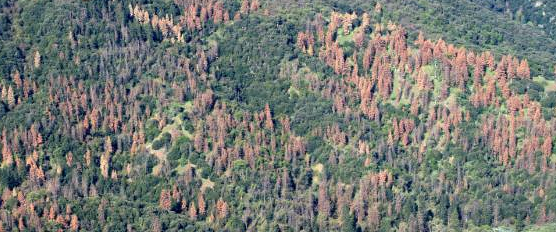
2015 Pine Mortality Near Tehachapi. By J. Moore, USFS.

The US Forest Service, Forest Health Protection conducted special early season aerial surveys of Southern California and the Southern Sierras in April to get a preliminary assessment of forest conditions in some of the most severely drought-impacted areas of the state. The Southern California survey covered more than 4.2 million acres and identified approximately 2 million dead trees over 164,000 acres. It included most of the Cleveland, San Bernardino, Angeles, and Los Padres National Forests as well as Pinnacles National Monument and nearby private lands. Noteworthy finds included a substantial increase in pine mortality on the Descanso Ranger District of the Cleveland National Forest as well as a large area of scattered live oak mortality south of the Palomar Ranger District. Increased pine mortality was also observed on the San Jacinto District, and large areas of live oak mortality were observed along the southern extent of the Angeles National Forest. In Los Padres National Forest, expanded severe Jeffrey and pinyon pine mortality was observed, and private lands north of Pinnacles National Monument had extensive areas of Coulter and gray pine mortality, as well as live oak mortality, for a third year in a row.
TehachapiBugKill2

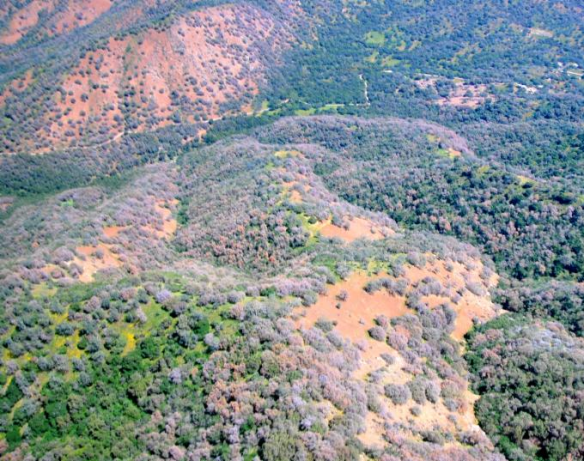
Hardwood Mortality in the Sierra Foothills. By Z. Heath, USFS.

The Southern Sierra survey included more than 4.1 million acres and identified nearly 10½ million dead trees over 835,000 acres. It covered western portions of Stanislaus, Sierra, and Sequoia National Forests and Yosemite and Sequoia-Kings Canyon National Parks as well as the Tehachapi Range and nearby private lands. Mortality in the Southern Sierras was quite severe in many pine species, especially ponderosa and pinyon at lower elevations and to the south, and foothill mortality was often widespread and severe, especially in ponderosa and gray pine. Mortality on the Stanislaus roughly doubled since July 2014 in the areas resurveyed this spring, with severe pockets of ponderosa and other pine mortality seen in the low areas to the south. On the Sierra and Sequoia National Forests, western pine beetle-associated pine mortality was common and severe at lower elevations, with an estimated 5 million trees killed, compared to about 300,000 trees last year in the same area. Southeastern portions of the Sequoia National Forest and wilderness areas further east also had intense pinyon mortality, and on the Tehachapi Range and private lands along the Sierra foothills, extensive areas of pine mortality were common.

Forestry Friday … Remembering Gilbert Murray

Gilbert Murray.

Gilbert Murray

Gil Murray’s life ended twenty years ago today. He was the final victim of the Unabomber Ted Kaczynski. Gil was a Registered Professional Forester and leader in the California forestry profession.  When I first met him, he was head forester for one of our local competitors. He was later hired to lead the California Forestry Association, a promotion that led to his death. Gil was deeply respected in the forestry community as a man of the highest character. I tip my hat to Gil Murray.

Forestry Friday … Crystal Forest

Douglas-fir, old growth, freezing fogThis wasn’t your everyday old growth Douglas-fir forest. When a freezing cloud layer settled in, it became a crystal forest.

Crystal-Forest3Crystal-Forest1No lesson today, just something cool.

Forestry Friday … Weather Station

anemometer, wind speed, fire weather

The anemometer measures the wind speed and direction.

California is into the fourth year of drought. Wildfire is on our minds in the natural resources community. Hazardous fire conditions are just around the corner and we are already preparing. The state and federal agencies have a system for predicting high fire hazard conditions, and tracking weather and fuel moisture is at the core of it.

weather station, fire weather, forestry

A portable weather station.

We utilize local weather stations on our timber lands to get pin point fire weather conditions. Our research department installs them. Some of these stations are permanent and some are mobile. The mobile stations, like the one shown above, can be relocated as needed. We put these at active logging sites so we can measure accurate on site fire weather conditions.

fuel moisture stick, fuel moisture, wildfire, fire weather

The fuel moisture stick measures moisture content in forest fuels.

Years ago, we used mechanical anemometers to measure wind speed, and fuel moisture sticks weighed with a scale to measure fuel moisture. During the summer season, measurements were taken on the hour by someone on the logging crew. When conditions became severe enough, operations were shut down for the day.

With today’s technology, we have the ability to monitor conditions continuously and have the data transmitted to our office. Changes in fire conditions can be spotted in real-time and radioed to the logging crews. We can collect much more data with the new weather stations than ever before, and respond to changing condition accordingly.

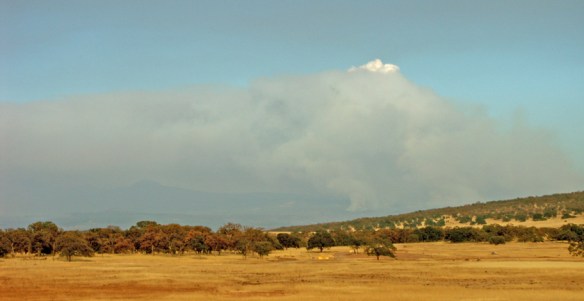
The Ponderosa Fire is still going strong on Tuesday evening.

The Ponderosa Fire.

The weather stations won’t eliminate wildfire, but they do assist the logging crews in avoiding being the cause.

Forestry Friday … Feller Buncher

logging sports, loggers, chopping, ax

A speed chopping contest between Oregon State University and Shasta College students. Logging sports like this were inspired by how it was once done.

Every time I see a news report where the reporter says loggers “chopped” down trees, I want to bang my head against the coffee table. Loggers haven’t chopped down trees since chainsaws took over the job in the 30’s and 40’s.

chainsaw, logger, logging, faller, falling, felling, bucking, limbing

Using a chainsaw to limb a Ponderosa pine tree.

Chainsaws are still on every logging job, but now they share much of the tree falling duty with the feller bunchers. These machines look more like something from Star Wars. It’s not what most folks would expect on a logging job.

feller buncher, falling, felling, cutting, timber, loggers, logging

The disk on the front of the feller buncher is the saw blade. This type of saw head is called a “hot saw” because it runs constantly.

This machine is working on a fire salvage operation from last years wildfires. They cut trees all day long.

They grab the trees when they cut them. The trees are then stacked up in a "doodle" for the skidders to take to the log landing.

They grab the trees when they cut them. The trees are then stacked up in a “doodle” for the skidders to take to the log landing.

Life is a lot different for the loggers these days. Working in an air-condition cab is a world away for the days of axes and misery whips.

Forestry, mentoring, education

This tree shear is another example of tree cutting technology. Don’t worry, we let her go.

March 21–International Day of Forests

Linda Martin Andersen invited me to write a guest blog. Come check it out!

lindamartinandersen's avatarA Writer's Playground

A Writer's Playground Fotosearch_u17996074 “March 21–International Day of Forests” with guest blogger, Tim Livingston.

I can’t think of anyone I’d rather hear discuss International Day of Forests than Tim Livingston.  He’s the forester artist who blogs here:  https://theforesterartist.com/

Here’s Tim with lots to share…

International Day of Forests

image002

International Day of Forests is a day designated by the United Nations to promote the importance of trees and forests in our lives.  A worthy cause in my book for sure.  In the United State we’re fortunate to have a mature forestry profession.  I feel blessed to be a part of it.

image004

In contemplating what this day means to me, I reflect back on experiences that I’ve had. I have only practiced forestry in the United State, but I’ve had opportunities to interact with forestry professionals from other countries a few times during my career.

image006

Once, we were visited by a group of forestry professionals…

View original post 414 more words

Forestry Friday … Protecting a King Sized Salvage Job!

The King Fire devastated almost 98,000 acres in the Sierra Nevada, east of Sacramento. Our company lost 18,000 acres of forest. Lately, I’ve had opportunity to spend time in the burn area. There is a lot of work being done by our foresters, biologists, botanists, and others to protect the resources so the timber can be quickly salvaged in an environmentally sensible manner. Most people never get to see what is done to protect the soil, water, cultural resources, and wildlife. In the gallery are images of just some of the work being done.

There is a lot of preparation that has to be done prior to logging. It has taken a large team of resource professionals to get the job done on a project this size.

Just for children a picture book about wildfire and the forest rehabilitation that takes place after a fire. Check out, Firestorm In the Forest.

Road Work Art Work

I’m an opportunistic artist. Time for making art is precious, so I find it where I can.

Click on the gallery if you want to get stuck at the road construction with me. Who wouldn’t, right?

Forestry Friday … Continuing Education 


I’m in Sacramento today listening to a talk on amphibians and reptiles. It’s part of the program at  the 2015 CLFA Spring Conference. CLFA is the California Licensed Foresters Association. 


Continuing education is important to keeping up on new developments, rules and news involving California forestry.  Personally, the most valuable part of the meeting is a chance to visit with friends and fellow professionals to catch up on what’s been going on.

The theme for today is all about wildlife, very interesting stuff. Foresters deal with wildlife issues every day. Often, we are the eyes and ears for the biologist. The forest management decisions we make affect wildlife and this information is vital in our process.


 It’s the last presentation before lunch. I’m looking forward to that!

Trinity Alps

That’s my view today.